Thursday, May 14, 2009

Foxy

(Click on photo to see larger version.)


"A family of foxes in the heart of Tallahassee", that's what my friend, Ann told me... and exactly where I could find them.
I've seen foxes occasionally and tried to photograph them, but they tend to be more active after dark, and are hard to predict. My best successes to date were sleepy-eyed gray foxes in the oaks at the Tallahassee Museum.


I was psyched. I arrived at the woodsy neighborhood well before dawn and located the den. There was a perfect shrub not far away where I could set up my camera low to the ground on a tripod and sit without being too invasive.

In a few minutes, I spied the rough-and-tumble kits wrestling and chasing each other. Then Mama arrived and made a futile effort to bathe her rambunctious babes who
wouldn't think to hold still. By the time the light had improved, I was an acceptable part of the landscape.

There were five handsome young red foxes who were old enough to have expanded their territory to 3 or 4 lushly-landscaped yards along this quiet street. One seemed more fearless than the others and soon came over to check me out. She got so close - a few feet away - that my telephoto lens couldn't focus, so I just sat quietly. She looked back at her awed siblings, (and I imagine might have stuck her tongue out at them) then sat down next to me to scratch at a few fleas. In a minute she bounded off on another game of chase.


Mama was gone and the kits were wild and mischevious, racing through yards, up on front stoops, diving into the den whenever a car or bike came by, and re-emerging a moment later. After awhile, Mama returned with a freshly killed squirrel. The kits were scattered, but bee-lined to Mama. From a tumbling ball of snarls, tails, teeth, and yelps, one kit shot out, squirrel in mouth, hightailing it, with 4 red-furred flashes at his heels. More yelps and cries from the bushes, and another emerged with the trophy. This game went on for awhile as chasers gave up one by one. I never saw the victor or trophy again, but enjoyed the other exhausted kits as they came back to nap, scratch, and laze around the entrance of their den. At this point, Mama had better success licking them clean. This family seems to be well adapted to life in the suburbs.

Since sending out one of my photos a few days ago, I have heard recent tales of three fox families in other neighborhoods around Tallahassee. We would welcome foxes to our yard - the squirrel population is exploding and the entertainment they'd bring is magnificent.

Wednesday, April 22, 2009

Heart of Cypress

(Click on the small thumbnails to see full image, then click Back, to the story.)


The Choctawhatchee River is in Ron and Kathryn’s backyard and an integral part of their lives. Most evenings they’re adrift in their boat sipping wine and watching the sun set over one of Kathryn’s favorite cypresses. Ron knows every bend and shoal along the river’s course, and has explored most of the tributaries and bayous over the years. So it is that Ron and Kathryn knew of a particularly giant cypress downstream, hidden back in the swamp off the main river. Some months ago, while visiting this tree with friends, there was speculation about the tree being hollow, and friend Nancy, looking for evidence, noticed a burl on the side of the tree’s base that was loose – and in fact, came off in her hands when she gave it a gentle tug, leaving a hole the size of a basketball. They peered into a dimly lit cavern inside the big tree.


It was to this hollow giant that Ron wanted to take us when John and I sat across from him at the Bruce CafĂ© in early March. Within a couple hours we were skimming down the mighty Choctawhatchee in Ron’s Carolina Skiff. And there it was – the grand tree dwarfing the surrounding swamp. After marveling at its size, we squinted into the hole Nancy had made. Looking up, I could see light at the top of the chimney-of-a-tree, its top having blown off in a former century. And looking down, the cavity floor was filled with cypress knees rising from the water. I knew I had to try to climb inside. This was not easy and took a few attempts before finding the right contortion to get in… and then I found myself, the first human - gingerly balanced atop the knees - in the sacred heart of this cypress.


Later, Ron measured the distance around the base of the tree: 42 feet! We spent the remainder of the day-into-dusk photographing and exploring the Big Tree, as Ron and Kathryn call it.


The next day, Ron snaked his boat through a creek a few inches wider than its beam into a small pond with another beautiful tree. This one was younger, but it gracefully leaned over the water, dripping with Spanish Moss, and crying out to be photographed. That evening, with a party (literally) of six, we re-visited the Leaner. Nancy brought the hors-d’oeuvres and wine, and John the 3 million candlepower Q-beam spot light. We had scouted an accessible spot at the far end of the pond from which we could see the Leaner. Ron dropped us ashore there just after sunset where a curious red-shouldered hawk flew in and landed a few feet away.


Ron and company returned to the middle of the pond near the tree. From there, he painted the Leaner with amber light while we shot a series of 30 second exposures. Ron’s local knowledge of the river and her treasures proved valuable again as we raced home in the dark to a feast prepared by Kathryn and a fire at riverside. The Choctaw doesn’t get any better than this.

Saturday, April 11, 2009

Florida Black Bears

For years, Crystal and I always wished we'd see a wild bear in Florida. Then, a few years ago, we did. It was a young long-legged bear crossing the road in front of us pretty far away - but it was the first! 2008 was our Bear Year. We saw a couple in St. Marks early in the year, and then came the bumper crop of acorns in the fall.

I was visiting my friend Ted in Eastpoint. He lives on the edge of the national forest and talked of the bears coming into his (sparse) neighborhood for the big oaks. The next day, as we were headed to St. George Island for the evening light, Ted said it's time we see some bears... and as I was replying that my camera was packed in its case in the back of the truck, we spied a mama and cub standing beside the low branch of a sweeping live oak gobbling acorns in golden light at close range - beautiful sight to see! They saw us too. By the time I got my camera, all I got was the two of them looking back from the edge of the distant woods. (Click on these thumbnail photos to see the full image, then use your Back button for the rest of the story). We went on to St. George psyched by the bear encounter and shot goldenrod in thebacklit muhley grass...
and later found a pelican-lined sunset.


So, when Ted called me early one morning the next week to say there was a bear in his oaks, I rushed down there to see if I might have better photo luck. It was pre-dawn and I had an hour's drive. I did take the time to put my camera and telephoto lens on the tripod and guess at the likely settings for shooting a black bear in early morning light before heading out.

As I approached Ted's house on his long gravel driveway, I thought I saw a large animal moving through the woods behind his house. When I got out (camera-ready), Ted said the bear was scared off by the noise of my vehicle, but "he would be back." He never came back, BUT, in just a moment the cub I'd seen the previous week ran out from the woods into a clearing, paused for a few seconds to look back at me, then hightailed it into the woods. Those few seconds were enough.


Predictably, Mama was nearby. Moments later, she came in from the same woods, paused in nearly the same spot, then followed her young'un, both gone for the rest of the day. Being camera-ready paid off again. While it's not the intimate moment at the oak in golden light, I was very pleased to have captured images of these wild shy creatures of our forests. Thanks, Ted!

Friday, September 12, 2008

Adventures with John

As usual, click on an image for a better view, then the Back button to return to the blog.

My friend and mentor, John Moran, was in my neck of the Florida woods recently and we had some great shooting days.

First stop was to be a stretch of the Florida trail off Wakulla Beach Road, but I ended up driving past the trail to the coast to see the 'big sky' and marsh in the nice morning light. The beach was crawling with fiddler crabs... way more than usual. So we spent a few hours photographing them. One particularly patient fellow was conscripted to be our model for some creative lighting shots. He clung to an oyster-covered rock, while we flashed flashes and zoomed in. John is determined to make me a better flash-user (I'm quite the novice)... this session really fired me up to learn more.

We got to the trail head in time for a quick late lunch, where we also fed the myriad mosquitoes with our blood. Tropical storm Fay left flood waters and the worst mosquito outbreak in years as her legacy. A little DEET helped. We biked the first mile. Then hiked the rest of the way to Shepard Spring. The trail was muddy and often had standing water. A finger of marsh across the trail stopped us for another couple hours while we photographed the swamp mallow flowers, and sundry bugs and frogs of the wetland. By the time we were passing through the Cathedral of Palms, we were exhausted and thirsty, so upon arrival at the spring, all we could do was peel off the sweat and DEET-soaked clothes and take a rejuvenating dip.

Sunset was approaching as we arrived back at the car, so what else could we do but zip down to the big-sky-beach again. We witnessed the beautiful light over the Gulf and marsh, made a few more images, and headed for home and a late dinner.

Very early the next morning, I took John to my old home on Lake Bradford (Leon County). For over 20 years I explored by canoe and kayak the chain of lakes that drains into the big lake, watching it cycle through fall and spring... floods and droughts. I had my favorite secret ponds in the middle of the cypress swamps and hold dear many memories of adventures with my children growing up there.

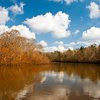
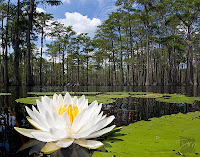
As we paddled back into the Apalachicola National Forest lands, I was initially disappointed to find an overgrowth of dog fennel choking the formerly beautiful cypress passages. But soon we passed into the clear swamps and ponds of tannic water and majestic cypress trees. Fay had refilled this system to perfect levels for access by canoe and kayak. The trees stood as sentries, reflecting their buttressed trunks across the dark waters. We found a patch of lilypads and one water lily in one little clearing. Nearby, John found a garden spider - a plain name for a jewel of an insect- strung between two not-so-close cypress. We marvelled at the making of such a web and John gave me more lessons on off-camera flash and composition. Another magnificent day.

As we parted ways that afternoon, my head buzzed with excitement from our adventures (or was it the drone of mosquitoes?). Hope you can get a feel for these wilds of North Florida from my photos. And thanks for coming along via my blog! dm

Wednesday, September 3, 2008

The Confluence


Click on photos for a better view, then your Back button to return to this blog.


Irwin came up with the idea: paddle down the Wacissa River from a popular launch site at Goose Pasture... but this is the put-in for the Slave Canal paddling trail?!


After the Slave Canal branches off to the right, the Wacissa-River-proper divides multiple times and fades into 'the braided swamp'. Stories of paddlers who MISSED the turn into the Slave Canal -- getting stuck, finding their way back to Goose Pasture after dark, losing their way, needing rescue -- swirled vaguely in my memory, as I said "yes, I'd love to go."


As we paddled down the open Wacissa, marveling at the giant cypress, wild rice, and wildflowers, Sue asked why this wasn't a regular paddling trail.


Swallow-tailed kites circled over us at our lunch stop as the clear cool water beckoned us to swim. We saw a nest of freshly hatched alligators (where's mom?).


There WAS a stretch of 'braided swamp' where the walls closed in. I put my camera away as we felt our way along, tried several dead ends, and crossed a few downed trees, but it was not so challenging or mysterious as I'd imagined.


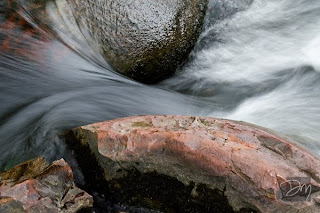
What I hadn't imagined was the reward at the end of the swamp: the confluence of the Wacissa and Aucilla Rivers. The clear waters of the Wacissa poured down over huge boulders into the dark tannic waters of the Aucilla. Tall palms stood on the banks over pools and mini-waterfalls.


We hung out there for a long time and soaked it up. Then we paddled upstream along the half mile stretch of the Aucilla to the landing where Irwin's truck awaited.


Rain was lightly falling by then and the limerock bank glistened against the tea-colored water. I made one last river photo and promised I'd be back.


Monday, August 25, 2008

Wildlife 2060

(Click on any image for a better view - then Back button)

"Florida's population to DOUBLE over the next 50 years!" That was the conclusion of a research project called Florida 2060 released by 1000 Friends of Florida two years ago. Maps delineating urban sprawl were shocking, showing the loss of 7 million acres (equal to the state of Vermont) of rural and natural lands.


In response, Florida Fish and Wildlife Conservation Commission prepared a follow-up report to show the impact that 18,000,000 more humans will have on Florida's wildlife. It is called Wildlife 2060: What's at Stake for Florida? And it has just been released. You can view and download a pdf of the report at http://myfwc.com/Wildlife2060/Docs/FWC2060.pdf And that's worth doing!


I feel honored to have a number of my photographs included in this impressive, if dire, report. I have included some of the images here to entice you to have a look at Wildlife 2060. The report is short but powerfully written by Susan Cerulean (http://www.susancerulean.com/), and the creative graphics designed by Faye Gibson, illustrate some of the points -- for example how many other animals and what types might be lost from the development of one black bear's home range of 25,000 acres.


There are stories about the plight of the sea turtles, the fragile state of our freshwater rivers and aquifers, and various Floridians' efforts to set aside land for conservation and restore lost habitat.


Check it out, become more informed and inspired to join the voices calling for careful balanced growth. dm